
Crazy about Ornaments!
I believe that in every artist’s journey, there are moments when you feel you’ve hit the core—or at least, you’re getting very close. For me, many of those moments have been about ornaments. I simply love drawing and painting decorative lines.
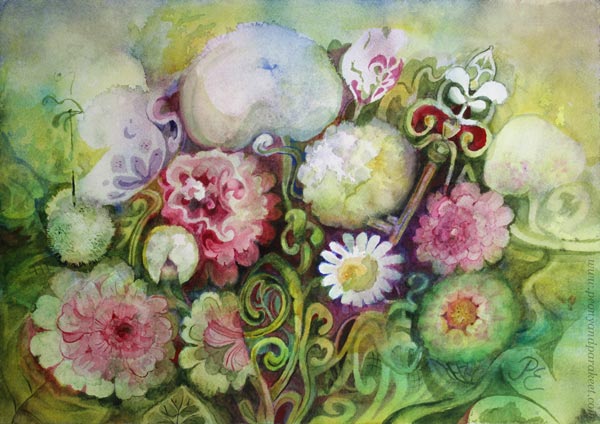
>> See more pics and a video at Taiko Online Art Store
This week, I share a recent watercolor painting that is full of ornaments and how I fell in love with ornaments in the first place.
Ornaments in Watercolor
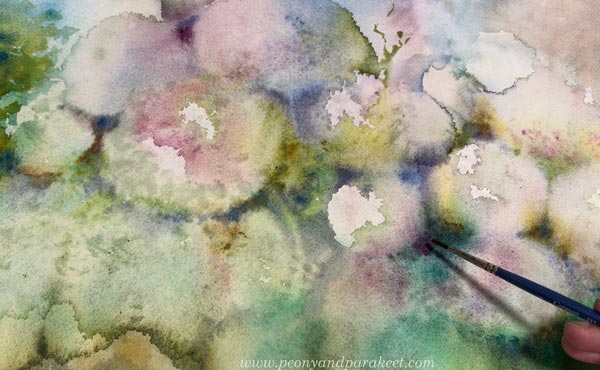
This is how the watercolor painting started.
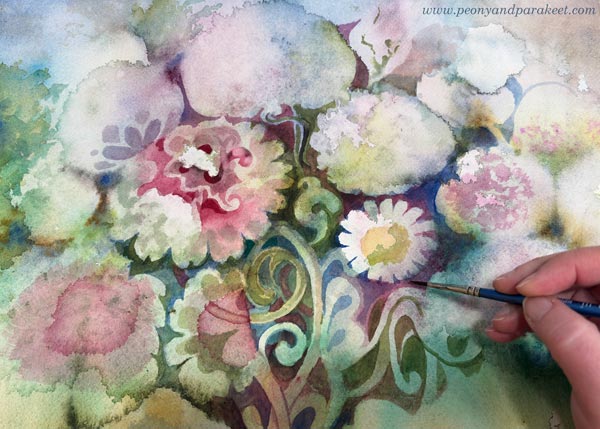
Ornamental shapes are much easier to draw than paint. In 2020, I made this watercolor painting.
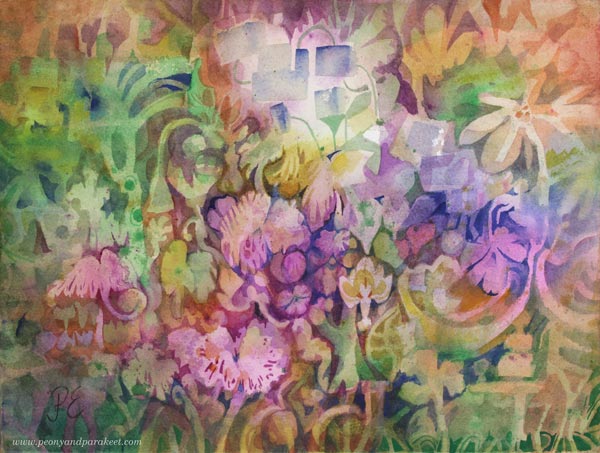
I can now paint much more elegant shapes.
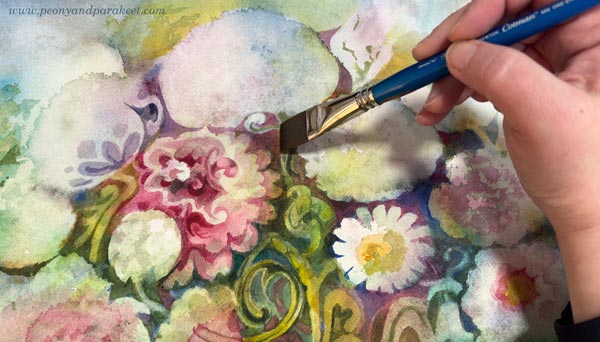
I have been after this skill for so long.
Ornaments – Are They Scary or Harmless?
An ornament is an animal. At first, it’s like a fox that is a bit too tame. You meet it on an evening walk and feel like shouting: “Don’t follow me, I’m not giving you a home!”
Then someone says, “It’s just an ornament, a harmless little decoration. It’s not a fox, it’s a bird.” And that’s when I realize I am dreaming about a magpie, picking only the oldest and most beautiful spoons from the pile.
But when I go to my imaginary pile of spoons, I see snakes. I can only catch the slowest and clumsiest one. My line was quite ugly for a long time, yet it has been my mascot for years. For just as long, I have been searching for the core of my expression.
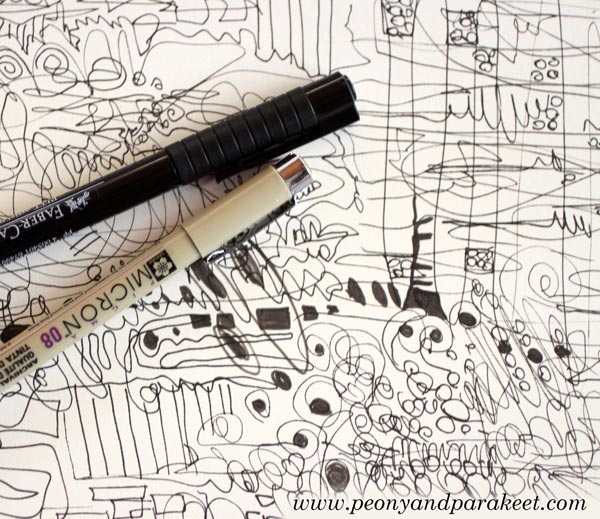
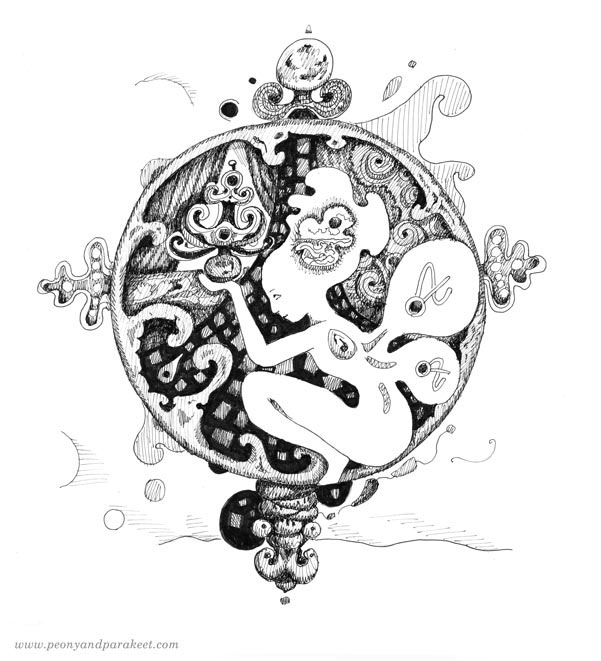
In 2018 and 2019, my drawing skills took a jump, and I was able to incorporate more and more ornamental expression into my drawings. I participated in Inktober and built two drawing courses: Animal Inkdom and Magical Inkdom.

Looking Through The Lens
Lately, I’ve read many descriptions of artists—both by the artists themselves and by critics. It felt as if I were forcing myself to read tiny text through a small lens, all while swallowing an ornament-shaped lump in my throat.
I believe the most accurate descriptions of how art is born are linked to childhood. My love for ornaments comes from my own.
Our family wasn’t wealthy, but we were dreamers. We followed the lives of European royalty with admiration. The large yard of our old wooden house, with its meadows and little woods, turned into a queen’s castle in my mind. I imagined grand halls, furniture, and a magnificent atmosphere. Nature became my palace once I understood that a plant should be looked at as a structure, not just a decoration.
From a Clumsy Snake to Expression
In the process of making art, however, the ornament is not a child, but an old soul. When a line is still young, it has no idea of the wisdom and beauty it can eventually store within its curves.
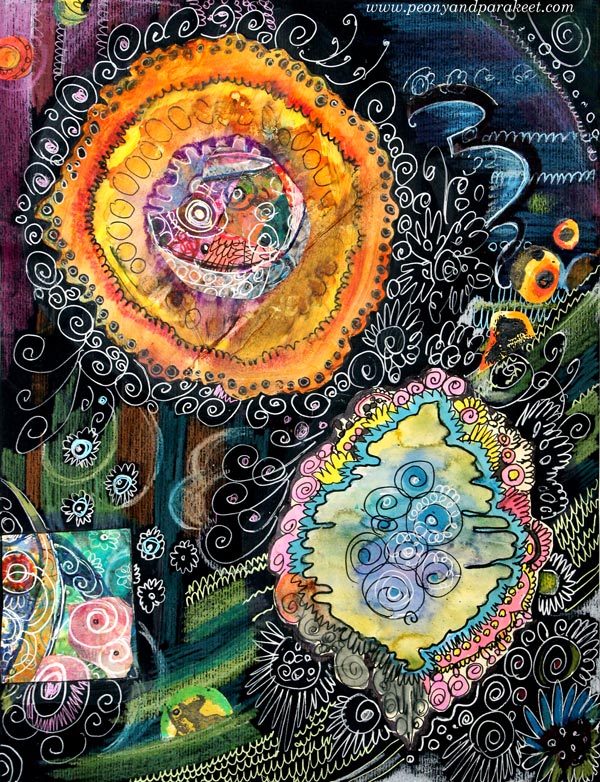
I believe that anyone who has the patience to feed their “clumsy snake” will eventually be rewarded. This madness—this love for ornaments—begins to transform from simple decoration into pure expressive power.
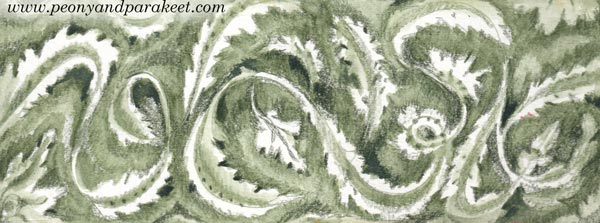
Almost all of my drawing courses are about developing a living line that can then transform into an ornamental one. A great courses to start are the colored pencil courses, especially Mystical Minis.
Painting Ornaments
It has taken me a long time to paint more ornamentally. I have had to learn to imagine an ornament as a 3-dimensional structure rather than just a decoration.
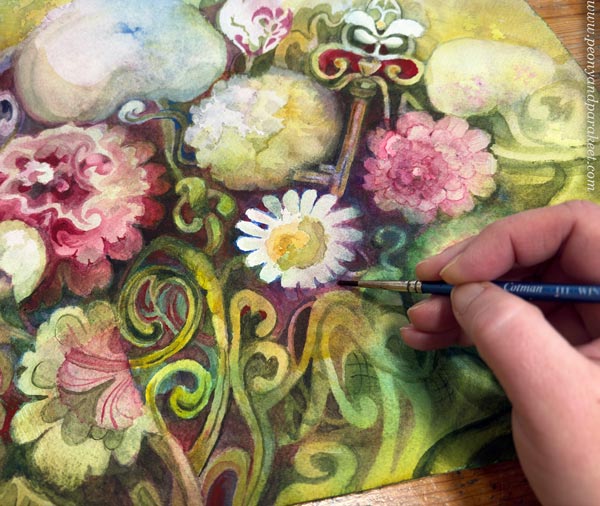
Now that I can paint like I used to draw, I can add many things that I have missed from that era, for example, tassels.
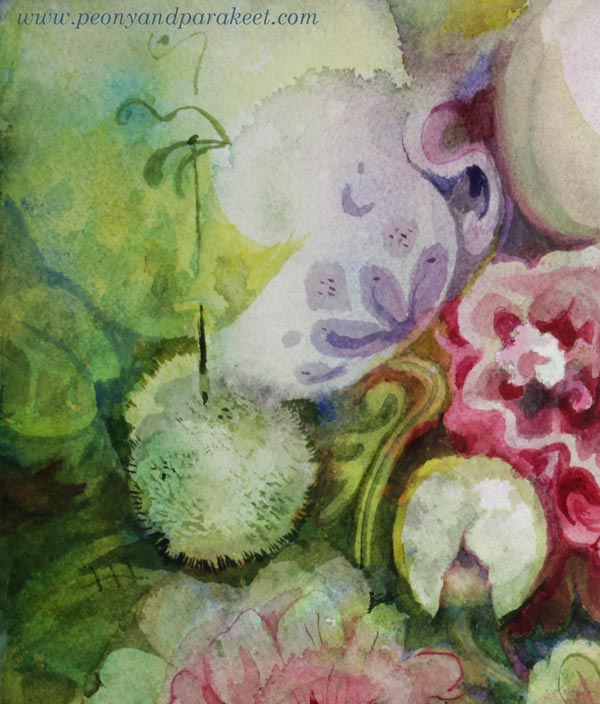
I can now also include what I learned from decorative painting when creating the course Decodashery.
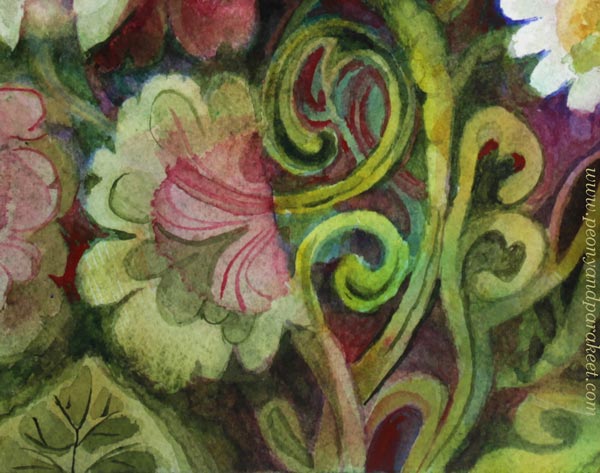
There is a sense of the medieval and the Baroque here, blended with the historical fantasy and folklore.
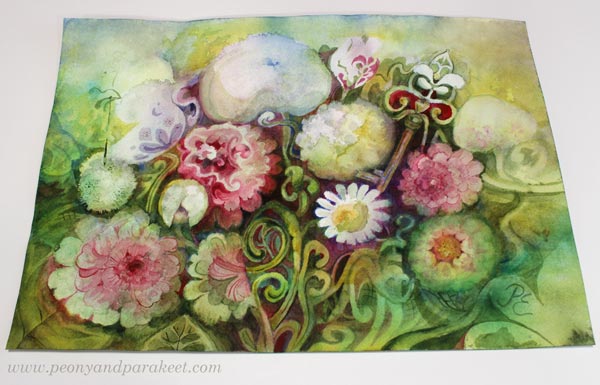
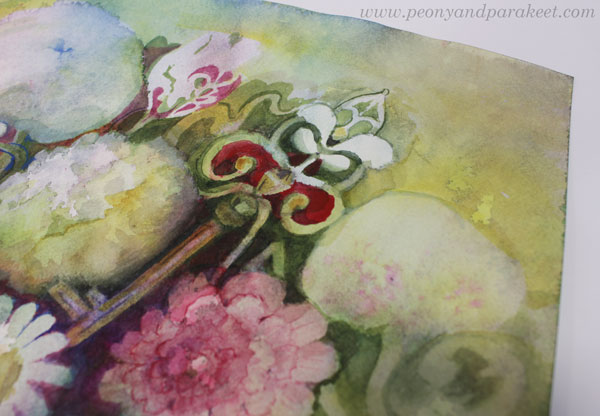
I have also worked in this ornamental style not only in watercolor, but also in oil, but I will share those projects later.
In the world of ornaments, every line has its own age. Is your line still a curious child, or is it beginning to store the wisdom of an ‘old soul’? Tell me about your process in the comments!
Making The Art Journal More Magical
I have been working on my square-sized art journal again. This week, I share a couple of magical art journal projects that include hand-drawn collage pieces.
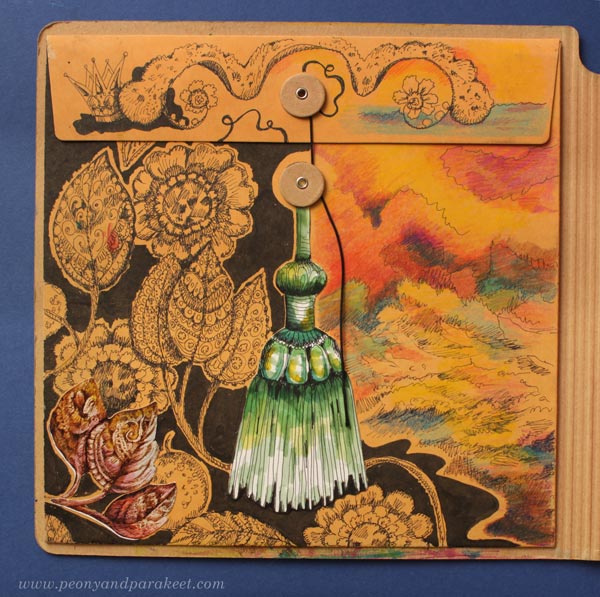
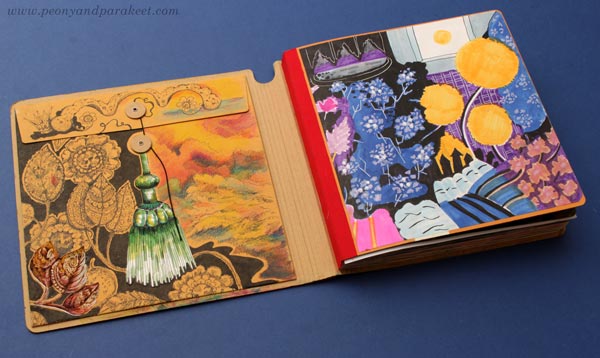
My journal is Dylusions Creative Journal. The first project is the decoration of the pocket envelope that’s on the backside of the front cover.
The Magical Mindset for Art Journaling
My journal is almost full, but I have decided not to hurry with the last pages. Recently, I have started to think that using what I have is better for me. That if I rush with the last pages and buy a new journal, it’s not as good as if I slow down and fully honor those few blank pages. You could call this a magical mindset because it makes you appreciate what you already have: skills, little drawings, time, blank paper.
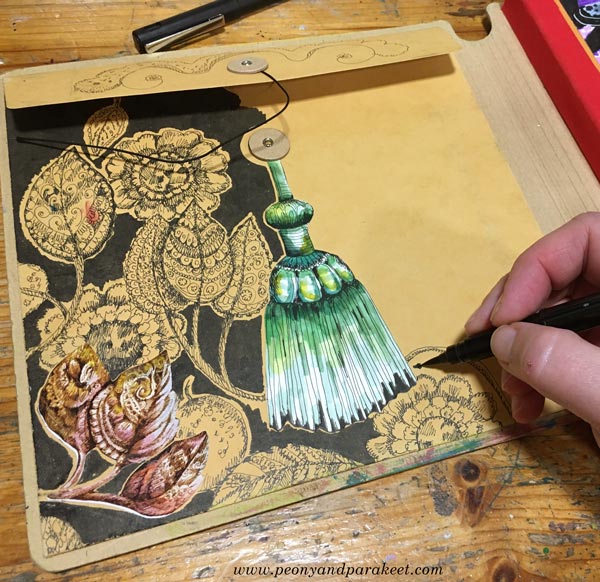
With the magical mindset, you don’t just look forward and think what you could have. Instead, you look back and focus on how you can take the old to the next level.
So, I went to my boxes of joy – the boxes that store my handdrawn collage pieces – and picked a set of leaves from a few years ago and glued it on the envelope. The leaves are a print and smaller than the original drawing. I love some of my handdrawn pieces so much that I have scanned and made prints of them.
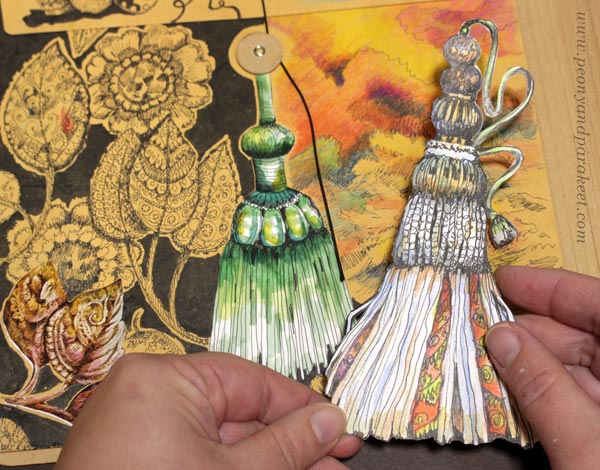
I drew some more leaves and then glued the tassel which is an original drawing too. The tassel divides the image in two parts. I drew and colored a seascape on the right side of the tassel.
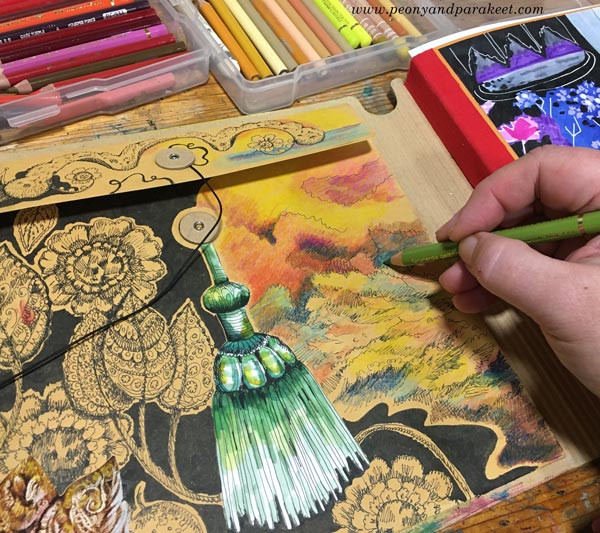
I love the oldfashioned and luxurious look of the envelope now. The inside cover was made earlier with markers.
I had two tassels to choose from. I love them both.
Magical Stripes on Art Journal Page
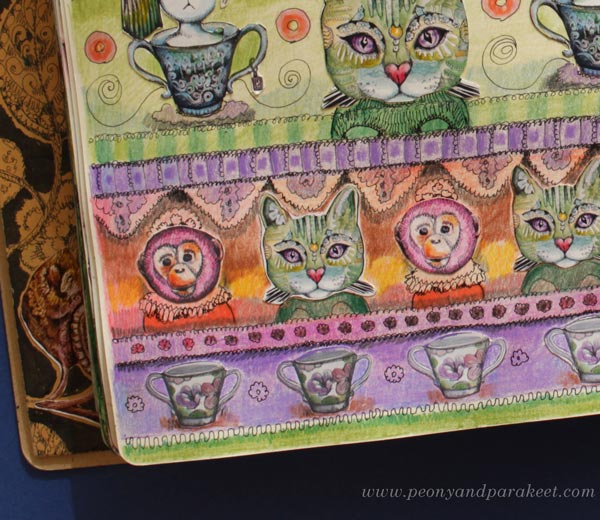
The second project is a page with hand-drawn collage pieces. The idea here is to draw stripes and then decorate them. I made my page so that some of the decorations extend over the stripes.
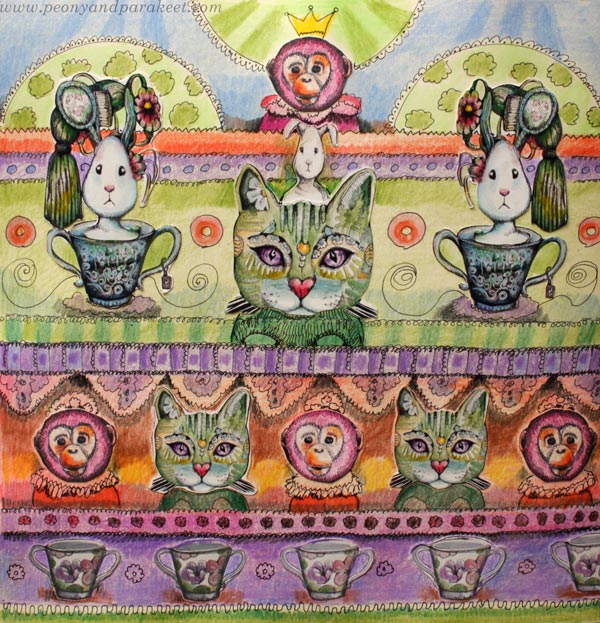
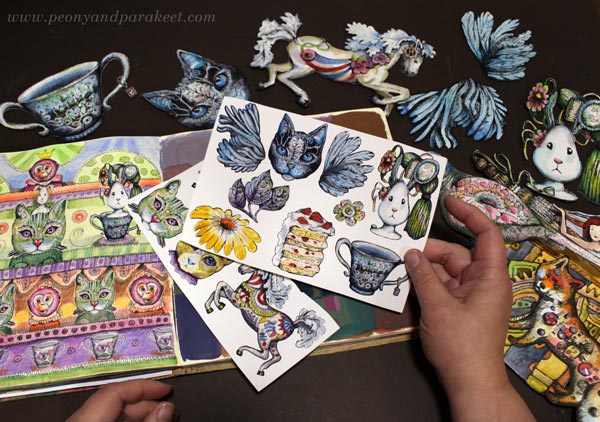
The teacups, the heads of the cats, monkeys and rabbits are prints made from bigger hand-drawn pieces. The rest is drawn with a black drawing pen and colored with colored pencils.
Here you can see the print sheets that I have made for myself and the original drawings. These are all drawn for the courses Magical Inkdom and Animal Inkdom. I had so much fun making these courses. The details are magical and I think the stripy page became magical too.
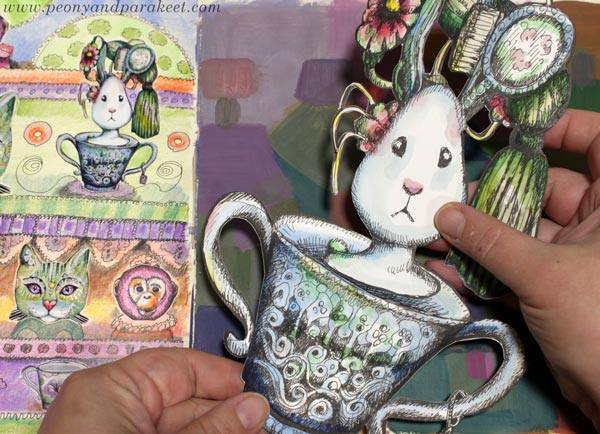
The rabbit and the teacup are two separate pieces.
I have randomly created on the pages over the years. The page on the right is painted and very different in style, but I think these are just layers of time. Like home, an art journal can have some old pieces, some newer ones, and some that connect all the years. I started my journal in 2020.
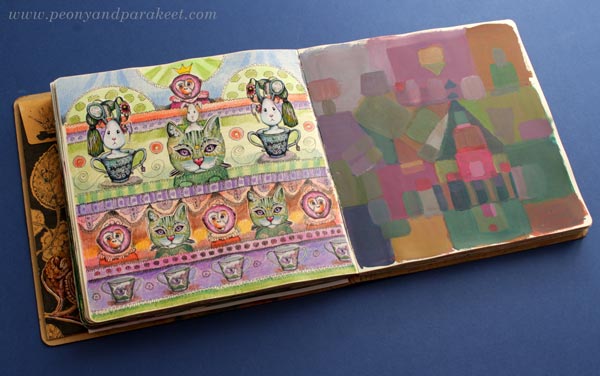
The abstract house could be the place where this magical tea party happens.
Magical Letters
In the previous blog post “Mini Drawings on Art Journal Pages“, I showed a spread that was still in progress. That’s finished now. I think letters on the black background with some leaves and flowers look magical too.
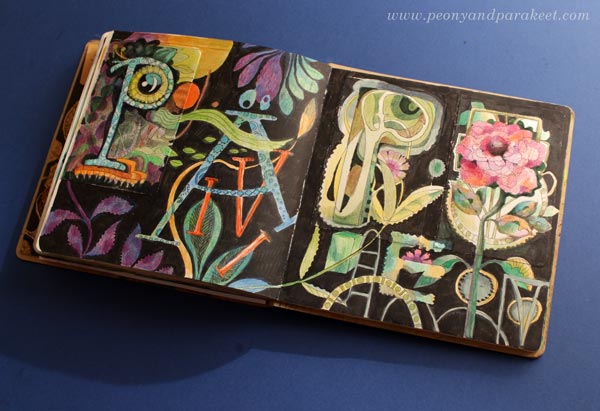
I hope these projects inspired you to make your art journal more magical!
Half-Empty Art Journals I Should Fill Up
Last month, I went through my art supplies and wrote a post about the supplies I shouldn’t use anymore. After the post, I gave most of those useless-to-me supplies away. Now I have reviewed my art journals and have come to the conclusion that I have too many half-empty ones. I should fill these up and at the same time, end one era in my artistic journey.
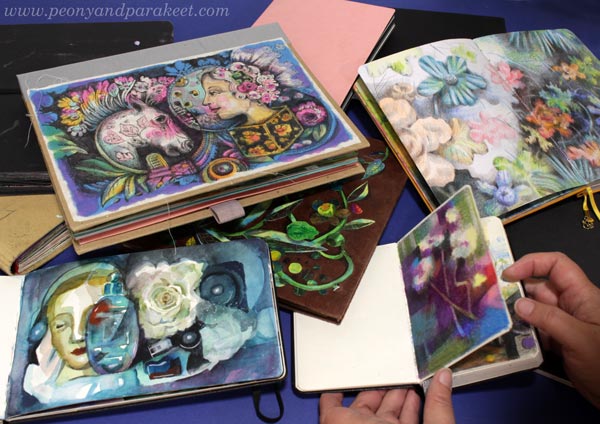
I don’t mean I shouldn’t have any art journals or sketchbooks anymore, but I think I could do well with only one or two. I have grown my skills by drawing a lot, but now I feel I am more of a painter. Most of my creative energy nowadays goes into painting, and I mostly make either watercolor or canvas paintings. So, the books don’t serve me as much as they have in the early years.
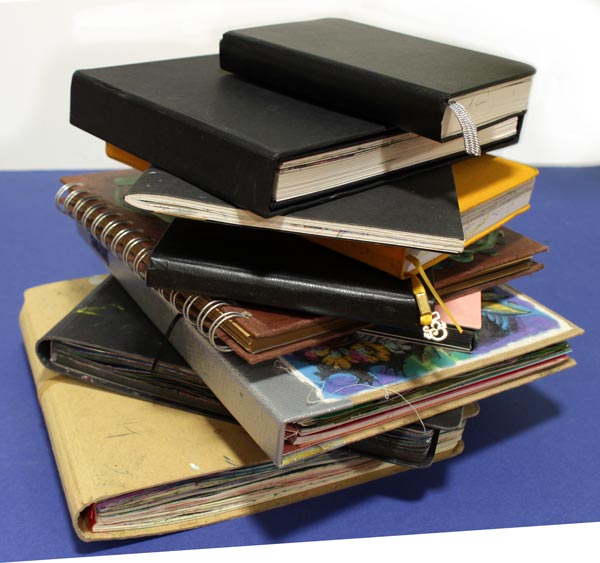
Ten of my art journals are half-empty. I don’t think it’s realistic to fill them in a short time. On the other hand, I have small pieces and hand-drawn motifs that I could attach to the pages and make collage art. Anyway, I wanted to share my inventory. Time will tell how quickly these will be filled!
Art Journal #1 – Smash Book
Who remembers the Smash Books by K&Company? I have several, but only one of them is unfinished. This one has the best cover as I have attached my fabric drawing to it.

This journal has all kinds of pages, but I want to show you the spread that has slow stitching. I have just glued the hand-embroidered fabrics on the pages.
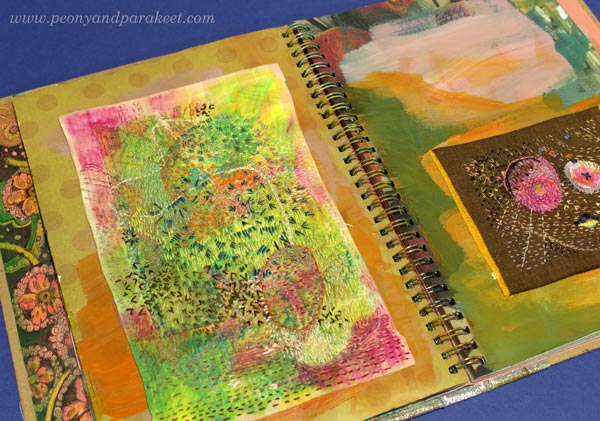
Maybe I could continue this journal with the fabric theme and search for other hand-embroidered pieces from my needlework stash?
Art Journal #2 – Accordion Book
This art journal is really fancy. It’s an accordion book with a separate casing. The paper holds watercolor well but it’s smooth enough for drawing and coloring too. I have got this as a gift from a student of my courses.
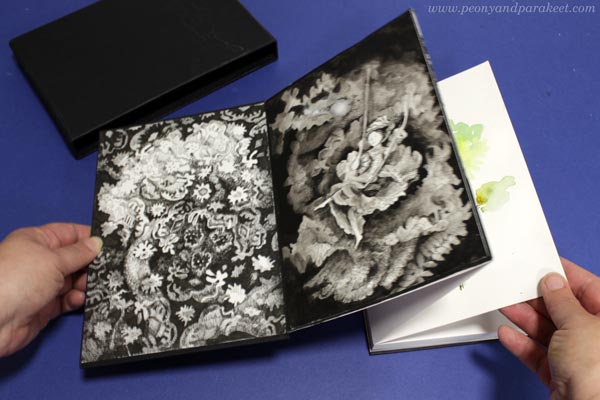
This journal has quite a many filled pages, but as it’s an accordion book, I could fill the rest of the pages with a watercolor painting that would continue from one page to another.
Art Journal #3 – Spiral Bound Sketchbook
I shared the process of making the collage cover in this blog post from 2020.

When I start making a new course, I often buy a new sketchbook, and that’s what happened here too. This book has mostly portrait drawings. They were drawn when practicing and gathering ideas for the course Innovative Portraits. Some portraits are very abstract like the one below.
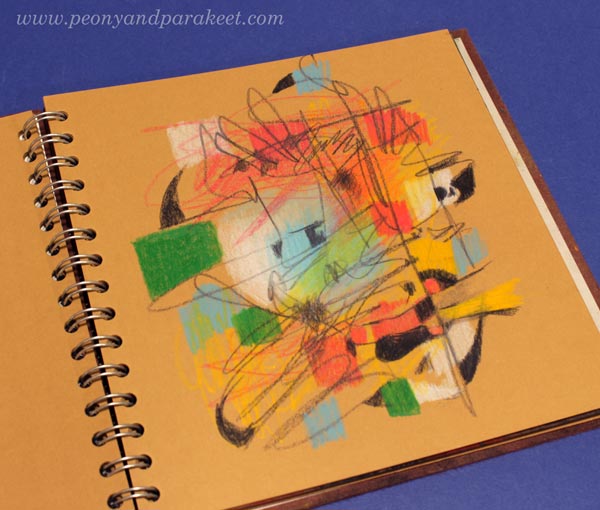
This book has still many empty pages. Here, I could gather other face drawings that I have made over the years. I think that at some point, every artist wants to draw faces.
Art Journal #4 – Small Sketchbook
Most of my art journals are filled with colorful art and contain fairly little writing or black-and-white sketches. This little sketchbook has some interesting ideas and it’s more like a notebook about art-making.
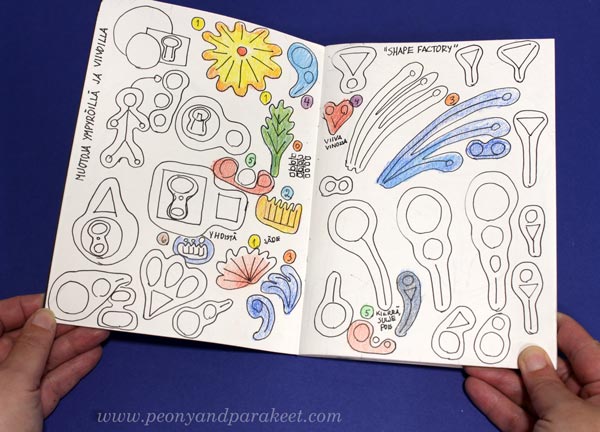
This sketchbook is almost full, and could be filled very quickly with the ideas for the upcoming paintings and courses.
Art Journal #5 – Colored Pencil Diary
This journal is an Archer & Olive Notebook that I call my colored pencil diary. I have filled many pages already. For example, see the blog post about coloring without limits!
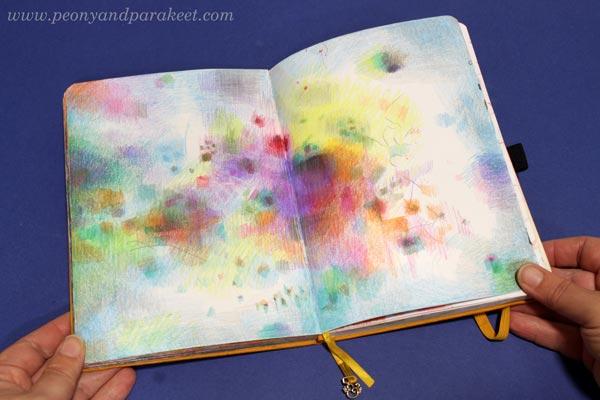
My favorite part of the book is the chapter that has fun plant-themed pages. I made them for the course Fun Botanicum.
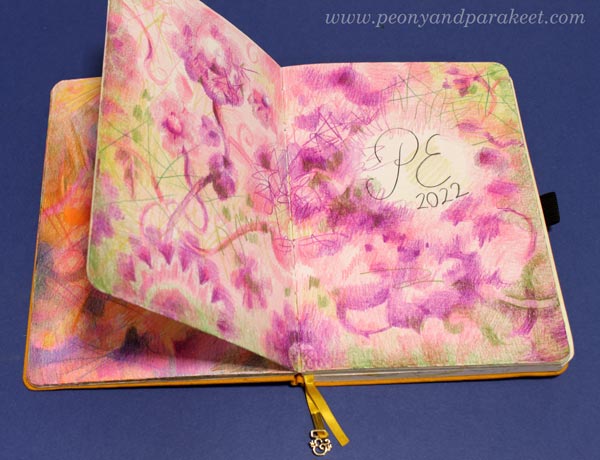
Even if this journal has many filled pages, it still has a lot of blank pages. However, I feel the journal is ready to be called finished. Should I remove the blank pages? What do you suggest?
Art Journal #6 – Bullet Journal
I love bullet journals but don’t usually draw in them. However, in 2018-2019 I bought a dot-grid journal just for small drawings. These became inspiration pieces for the course Animal Inkdom.
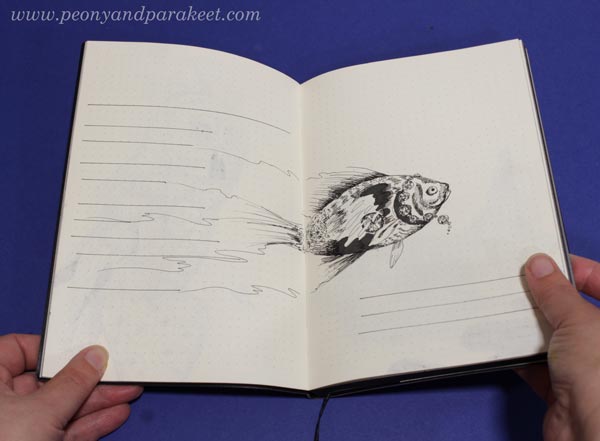
The drawings leave room for writing, and there are many empty pages left. I think I should remove this journal from my art journal shelf and use it for bullet journaling once my current bullet journal gets full.
Art Journal # 7 – Tiny Sketchbook
My smallest art journal is still quite empty. It has some lovely drawings, though!
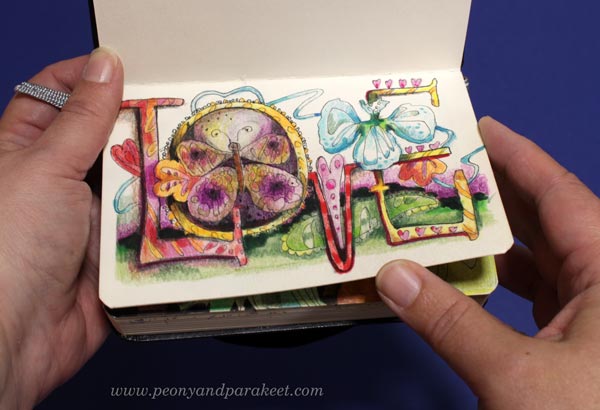
Should I continue this, or just take out the pages and glue them on another art journal? When I carry a journal with me, I prefer a bigger one.
Art Journal #8 – Dylusions Creative Journal Square with Black Pages
Dylusions Creative Journals are sturdy and their paper is quite thick. I like to practice painting by filling their page. Black is a nice background, especially when I use leftover paints from the palette.
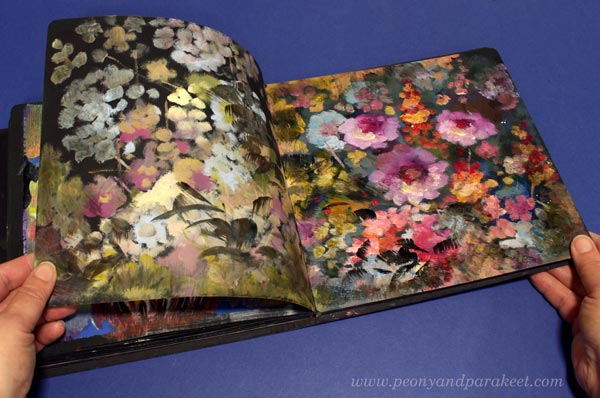
This is the kind of journal I still want and need. It will get filled over the years and there’s no pressure to do it right away.
Art Journal #9 – Moleskine Watercolor Notebook
Moleskine watercolor notebook is a small journal, but it has lovely panorama spreads and nice paper. See this blog post for more inspiration!
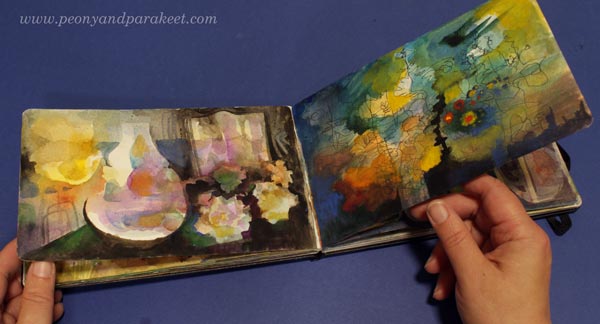
I am going to continue this one, for sure!
Art Journal #10 – Dylusions Creative Journal Square with Cream Pages
Dylusions Creative Journal with cream-colored pages is my favorite art journal. This journal works well with colored pencils, for example, see this drawing tutorial of Vermeer Girl!
The inside cover is colored freely with felt-tipped pens. I used thin marker paper for the drawing and then glued the paper on the cover.
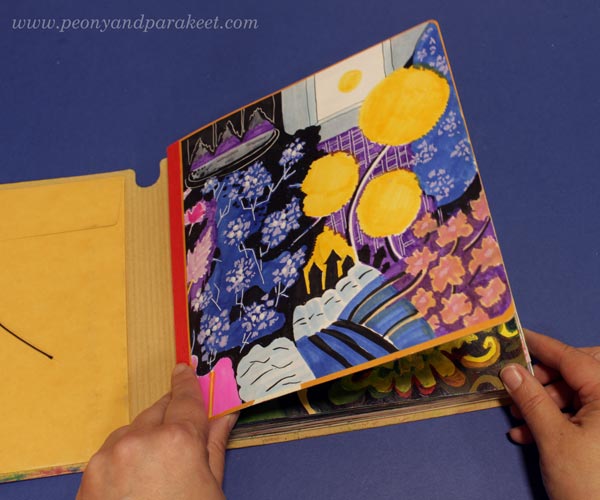
I started this journal about five years ago, and have almost filled it. But I like to keep working on the older pages, making them more beautiful. Like with the black journal, leftover paints find their way here.
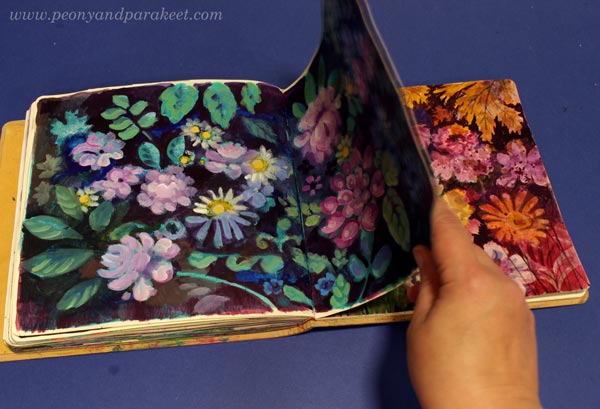
The paper holds water fairly well, and I use watercolors, acrylics, and oils there. I only wish that the paper would be bright white, not cream-colored. When the journal is full, I will record a flip-through video of it.
Half-Empty Art Journals – Question!
I have a shelf that has many full art journals. I have now put the half-empty ones on the right, so that they don’t get mixed with the full ones.
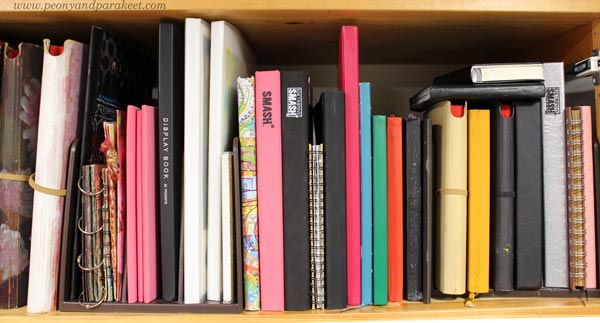
How many half-empty art journals do you have? Leave a comment!
Wild Garden – Paint with Me!
In the upcoming course Wild Garden we will paint flowers freely, intuitively, and expressively in watercolor. Watch the video and sign up now!
Wild Garden will begin on September 22, 2025. Sign up here!
Filling an Art Journal
One of my projects this summer is to fill one of my art journals – Dylusions Creative Journal Square. I hope that these pics from my current in-progress journal, inspire you to start filling your art journal!

Reaching Saturation Point in Filling Art Journal
I think art journals have a saturation point. When most of the pages are full, you have to give the book a little more attention than usual. This journal was started in 2020, and I have filled it here and there over the years.

One spread can have things done in many different years. So the book is full of temporal layers, and I think they make the best art journal.

and finally added a zebra made in the style of Animal Inkdom.
Magical Inkdom also has fun projects for these kind of small drawings.
Practicing in an Art Journal
My courses appear a lot in my art journal, because I often practice on the pages or later glue pictures I made for the courses into it. I hope my course participants do the same!

and then added some more painted petals in acrylic.
Journaled “Sweet” with watercolors.
Part of being an artist is to be happy with your own development, and also to be interested in what you have done before.
This and That Will Magically Come Together
When my art journal is full, I will make a video of it, where I go through it and talk about each spread. I also know that when the journal is finished, the flow of the spreads feels much more coherent than when I was filling them.
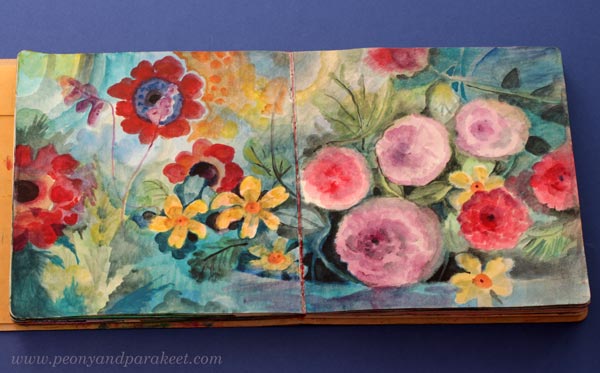
In the style of Freely Grown.
One thing that applies to all art journals, sketchbooks, and notebooks is that they are most beautiful when full. When you purchase one, it looks too beautiful to fill, but once you hold a full one, it feels much more valuable. I am looking forward to that!